
Garbage Collection, Rectification & Disposal
The final edition of 'Eye on China' for 2025. Happy reading, and see you next year!

Worldview Weekly: What China’s Commentators Are Saying About The K-Visa
Anushka Saxena
On October 1, 2025, the Chinese government implemented a new visa policy to invite STEM talent from around the world to China. The new K-Visa intends to create an ecosystem where “young STEM scholars and researchers” can come to China without an employer’s certificate or sanction, and apply for jobs once they arrive. This ambitious policy proposal, announced on August 25, and brought into effect a little over a month later, is situated in a complex geopolitical environment where talent mobility is becoming central to economic and technological competition.
The K-Visa is different from the previous R-Visa and other visas introduced since Xi Jinping assumed power. The previous R-Visa, according to the Regulations of the People’s Republic of China on Administration of the Entry and Exit of Foreigners, is issued to “foreigners of high talent” who are needed, or specialists who are urgently needed, by the State. The call in 2013, and since then, has been to invest and build up an indigenous technological research and development base in China.
Outside of innovation and growth strategies, the geopolitical moment has potentially provided Beijing’s decision to launch the K-Visa, with an impetus. On September 19, 2025, US President Donald Trump issued a Proclamation, entitled ‘Restriction on Entry of Certain Nonimmigrant Workers,’ which mandates a US$ 100,000 fee for anyone applying to work in STEM fields in the US through the H-1B visa. In Trump’s first term in particular, H1B visa denial rates were at an all-time high (see Figure 1). Today, even as the denial rate has declined, with restrictive policies once again in place during Trump’s second term, STEM talent is likely to choose migration to the US cautiously.
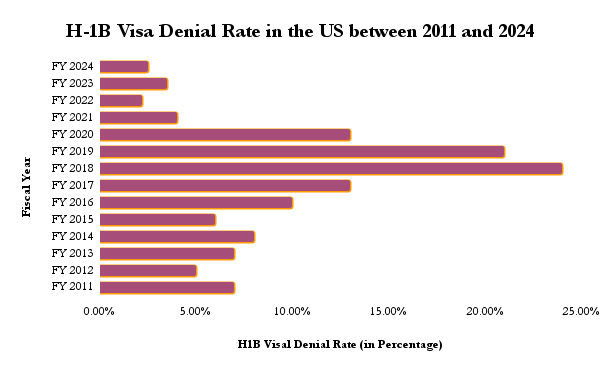
The allure of the H-1B, which conventionally targets all foreign talents in specialty occupations, is traditionally tough to compete with. ~65% of the visa’s applicants (in 2023) have been in “computer-related” jobs, while ~48% sponsoring employers (in 2023) are in the “professional, scientific, and technical services” domains. However, deepening nativist grievance and radical changes in American policies under the current Trump administration have opened a window of opportunity. Hence, it is likely that in the Chinese policymaking ecosystem, there is a prevailing sense that this is the time to tap into the high-skilled talent market in the hopes of carving out a significant share.
There are three strands of thought as to how analysts and commentators in China perceive these new regulations. In my latest Issue Brief for the Takshashila Institution, ‘The Talent Pill, Red or Blue?’, I classify these arguments as follows:
The Rivalist-Advocates
The first strand of commentators argues that leveraging the fee on the H-1B visa is a must, and that closing in on the US is the only way to capture the market. This strand of thought also entails optimistic outlooks on the future impact of the K-Visa on China’s growth in STEM domains.
This section of analyses is more optimistic about China’s prospects to become the next global talent hub. They pit this decision against the backdrop of declining American attractiveness for scientific-technological talent, and other countries seeking to capitalise on the opportunities created therefore. Wang Bin, a commentator with a news media platform (Chao News) in Zhejiang province, expressed this sentiment in a September 2025 commentary for Tencent’s QQ:
“The future of international competition is a competition for talent. Those who acquire talent will win the world; only by winning talent can we win the future. The rise of the United States is inseparable from its attraction of global scientific and technological talent. Now, not only China, but also countries like South Korea, Germany, and New Zealand are relaxing visa regulations to attract skilled workers.”
In essence, he argues that a global “talent war” is quietly underway. Hence, if China aims to gain a greater advantage in the competition for development, it must not only avoid falling behind in the talent competition, but also focus on developing unique strengths and excelling in areas where others lack them.
On the specific issue of the K-Visa, elite opinion in China, represented by state media and government-affiliated analysts, positions the visa as a critical tool for competition for talent mobility with the US. Proponents argue that as the US turns inward – citing 2025 hikes in H-1B fees and stricter scrutiny of Chinese researchers – China must “open its arms.”
Digging deeper, analysts and commentators speak of three main reasons why eased talent mobility, as enabled by the K-Visa, is not something that should spark concerns among the Chinese populace.
The first reason pertains to the benefits of potential technological breakthroughs that foreign talent may achieve in China.
The second reason pertains to bureaucratic confidence.
Thirdly, a niche set of officials also sees the “tourism” value in the visa.
The Gatekeepers
This is the extremist view on how a policy like this is devastating for a country that has been experiencing six years of economic slowdown. This view primarily comes from the younger population, and those who propound it deride talent coming in from countries like India as “foreign garbage” (洋垃圾), emphasising the linguistic, cultural and informational risks of enabling migration of foreigners to China.
Unemployment among the youth is a deepening concern for the Chinese economy. In the January-September period in 2025, China’s official data puts the overall national urban surveyed unemployment rate at an average of ~5.2%. This figure, however, does not capture deeper challenges. Youth unemployment, which captures the age group between 16 and 24, stood at a record high of 20.4% in April 2023, up from 19.6% in March that year. By mid-2023, it reached around 21.3%. Subsequently, at the time, the National Bureau of Statistics (NBS) revised its methodology to exclude university students in the unemployment rate calculations, even as it stopped publishing monthly data for the remainder of that year. When publication resumed in early 2024, only the overall national unemployment data was published, and for 2023, the average figure remained at ~5.2% (which the NBS demarcated to be a 0.4% decline from the previous year of 2022). Subsequently, for 2024, the average national urban unemployment data was ~5.1%, and no new data on youth unemployment was published.
This data does not reflect the fact that tens of millions of college students continued to graduate and seek an entry into the workforce. In fact, official data informs that next year, the number of China’s university graduates will reach 12.7 million – a new historical high. Hence, a lack of existing opportunities may likely be complicated by the freer entry of STEM graduates from across the world into China.
Largely, this stream of commentators focuses on two main challenges of the K-Visa. The first is that the eligibility criteria to avail the visa – a STEM Bachelor’s degree, and the waiver of the employment certificate criterion – are too low. Chinese scholars and netizens alike have pejoratively labelled potential applicants as “Foreign Garbage” (洋垃圾), i.e., graduates from “mediocre” overseas institutions who cannot survive in their own competitive markets. Popular commentators like ‘Pengcheng Shekou’ on Weibo, and their followers, expand on this sentiment. As Pengcheng stated in a recently released video:
“A cautionary tale from America’s ‘Indianization’! China must be extremely cautious with the domestic K-visa pilot program, or the consequences will be endless!”
The targeting of Indian talent that may potentially migrate to China by availing the K-Visa, is a common theme in the critiques of the visa policy.
The Pragmatists
The third strand comes from those seeking to convince the broader public that this move offers greater opportunities for the Chinese population, while acknowledging limitations and the need for regulatory reform. They argue that the K-Visa could be a catalyst for newer jobs, and that regardless of the skill level of foreign talent, there will always be a requirement for local anchors to help them communicate their work, and integrate their methods into Chinese development. Nonetheless, the party-state would have to ensure the mitigation of challenges that come with large-scale immigration, and enforce quality among those who are granted the K-Visa.
This more moderate camp situates the K-Visa within a broader trajectory of China’s talent-driven developmental strategy. Unlike the critics who view the policy as a radical departure from established norms, or the optimists who imagine it as an unqualified breakthrough, these analysts emphasise continuity. They do this by arguing that China has long expressed interest in attracting high-quality human capital, but is now being forced to accelerate reforms in response to slowing economic growth and intensifying global competition.
From this vantage point, the K-Visa is less a disruptive experiment than an incremental adjustment that can succeed if paired with robust regulatory oversight. Their arguments often highlight both the policy’s necessity and its risks, offering a pragmatic approach to encouraging public acceptance without glossing over the challenges inherent in large-scale immigration governance.
Addressing citizens’ concerns about foreigners taking Chinese jobs, analysts seek to show how talent immigration can complement local Chinese talent and drive economic growth. The latter will inevitably create more opportunities for locals to prove their mettle. This sentiment is expressed in an opinion piece by Zhou Chengyi and Hong Junjie for Jiefang Daily. They claim:
“The job market is not stagnant or static. The knowledge spillover effect brought about by young scientific and technological talents can actually promote economic and social development and release even greater employment opportunities. Foreigners holding K-Visas can engage in scientific research, education, entrepreneurship, and related business and cultural activities, which will also create more job opportunities and expand the employment ‘pie’.”
What more are the rivalist-advocates, the gatekeepers and the pragmatists saying in particular? What do their woes and sentiments signal about Beijing’s K-Visa policy? To find out, do check out my Issue Brief:
Dear Readers,
Before you proceed, I wish you happy holidays and a wonderful upcoming New Year 2026. Thank you for supporting ‘Eye on China’ in 2025. As you know, it is a free and open-source-based newsletter that relies on your goodwill to carry forward intensive discussions on the Middle Kingdom – especially from an Indian interests’ perspective.
Hence, I implore you to share the newsletter, and encourage those interested in your circles to subscribe. And if you’re interested in understanding all that the Takshashila Institution does in the public policy domain, do check out our flagship course, the Graduate Certificate in Public Policy (GCPP). The course also features three excellent specialisations – defence and foreign affairs, advanced public policy, and technology policy.
Apply here by January 4, 2026, and become part of an enormous community running the marathon to transform public policy!
Guarding the Great Wall: X-Mas Politburo Meeting
Anushka Saxena
On December 25 & 26, the CPC Politburo convened and conducted the annual “Democratic Life” meeting. As explained by the website of Communist Party Members Network (12371.cn – which, interestingly, is named so to combine ‘123’, the usual first few digits of official hotlines in China, and ‘71’, which pertains to the date of the founding of the Party in 1921 – July 1st):
A democratic life meeting is an important component of the Party’s internal political life. It is an important means of promoting intra-Party democracy, strengthening intra-Party supervision, and relying on the leadership collective itself to resolve contradictions and problems. Upholding and improving the democratic life meeting system is a major institutional tool for ensuring the Party’s unity and solidarity and for maintaining the Party’s advanced nature and purity.
Democratic life meetings should adhere to the principle of “unity - criticism - unity,” carry forward the spirit of rectification, fully promote democracy, and conduct active and healthy ideological struggle, so as to enhance the political character, contemporaneity, principled nature, and combativeness of intra-Party political life. Party-member leading cadres participating in democratic life meetings should carry out criticism and self-criticism in a serious and conscientious manner, uphold truth and facts, speak in terms of Party principles rather than personal feelings, and speak the truth rather than saving face. In accordance with the requirements of “looking in the mirror, straightening one’s attire, taking a bath, and treating illness,” they should put forward opinions earnestly and sincerely help comrades with full enthusiasm, so as to achieve the goals of unifying thinking, strengthening unity, exercising mutual supervision, and making common progress.
The idea is to essentially acknowledge that the CPC is a party of more than a 100 million members, and despite the otherwise centralised nature of governance and policy formulation, thinking of members themselves may not be monolithic.
And so, these year-ender “democratic life” meetings become a pathway to not just voice differences in ideological thinking, policy implementation practices, or other personal and professional opinions, but also to ensure that by the time discussions are over, there is “self-criticism” and “self-rectification,” eventually culminating in Party unity.
At the 2025 meeting in particular, there was no specific theme. There have been “special” thematic democratic life meetings in the past – for example, in 2021 and 2023, when the respective themes/ topics of focus were ‘Party History Study and Education’, and ‘Implementing Xi Jinping Thought on Socialism with Chinese Characteristics’.[I have prepared an ‘FYI’ table below to picture the central themes of the ‘Democratic Life’ meetings in the past 5 years, their dates, and any key conclusions].
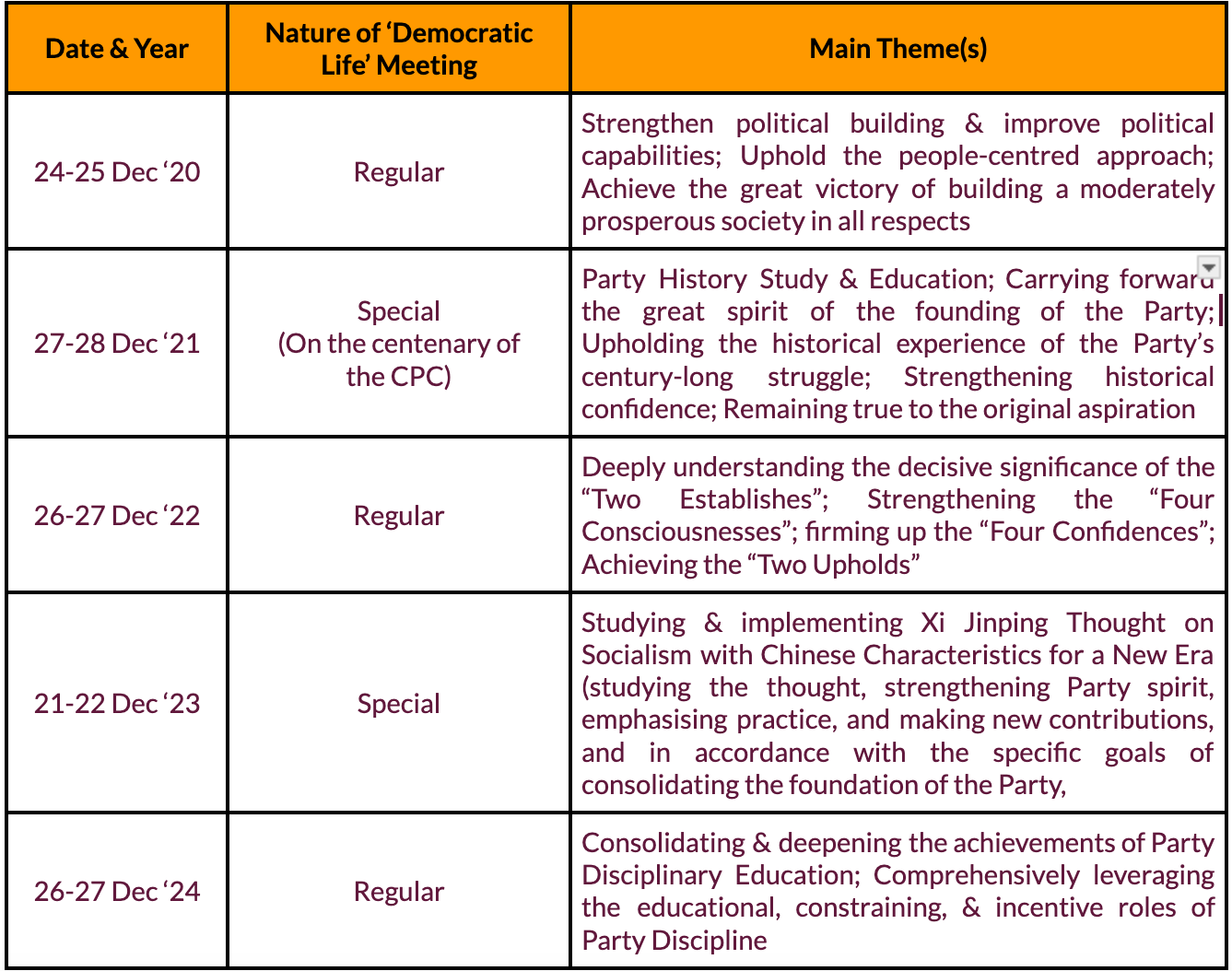
But the discussions this time around centered on two main aspects – studying the implementation of the ‘Central Eight-Point Regulations by the Politburo in 2025’, and fully implementing the guiding principles of the Fourth Plenary Session of the 20th CPC Central Committee in the future. It is in this regard, then, that participating members conducted “self-examination and Party-spirited analysis,” and carried out self-criticism.
Per the report of the meeting, before conversations officially started, Politburo members held heart-to-heart talks with responsible comrades, solicited opinions and suggestions, and drafted speaking outlines. Eventually, official endeavours commenced with the hearing of reports on the implementation of the Xi Thought, and on the work in 2025 to curb formalism and reduce burdens at the grassroots level. Members of the Politburo then spoke one by one, focusing on the meeting’s theme, benchmarking themselves against the Several Provisions of the CPC Central Committee Political Bureau on Strengthening and Upholding the Centralized and Unified Leadership of the CPC Central Committee and the Detailed Rules for the Implementation of the Central Eight-Point Regulations by the CPC Central Committee Political Bureau. They conducted “earnest” reviews and in-depth analyses, “spoke candidly and freely,” and maintained a serious yet lively atmosphere, “achieving the expected results.”
The remarks of the Politburo members focused on five key areas:
Taking the lead in strengthening political loyalty and improving political capability;
Taking the lead in consolidating foundations and strengthening Party spirit;
Taking the lead in respecting the people, respecting the organisation, and respecting discipline and the law;
Taking the lead in undertaking responsibilities and striving for achievements; and
Taking the lead in resolutely assuming responsibility for governing the Party with strict discipline.
The meeting interestingly emphasised that 2025 has been an extraordinarily challenging year. In the face of severe challenges arising from domestic and international circumstances, the CPC Central Committee, with Comrade Xi Jinping at its core, has united and led the whole Party and the people of all ethnic groups across the country to meet difficulties head-on and strive forward. In this regard, members of the Politburo unanimously agreed that the Party and the country’s new major achievements are fundamentally attributable to the strong leadership and steering of the CPC Central Committee with Comrade Xi Jinping at its core, and to the scientific guidance of Xi Jinping Thought on Socialism with Chinese Characteristics for a New Era. The whole Party must deeply grasp the decisive significance of the “Two Establishes,” strengthen the “Four Consciousnesses,” remain confident in the “Four Self-Confidences,” and achieve the “Two Upholds.”
Further, members concluded that, since next year marks the beginning of the 15th Five-Year Plan period, it is necessary to “resolutely implement the new development philosophy, accelerate the construction of a new development paradigm, and focus on promoting high-quality development” [The “new development philosophy” came about in 2015, but the “new pattern/ paradigm of development” has been popularised since the 20th CPC Central Committee 4th Plenum in October 2025].
On the economic front, the instructions were that efforts should be made to further “comprehensively deepen reform and opening up,” better coordinate development and security (instead of just balancing them them equally, which was a previous emphasis point), promote effective improvement in the quality and reasonable growth in the quantity of the economy, continuously improve people’s livelihoods, maintain social harmony and stability, and advance comprehensive strict governance of the Party in depth.
As the convenor and chair of the meeting, Xi and his remarks were at the center of the proceedings. He focused on a few important areas:
He emphasised the need to rectify the “Four Forms of Malpractice” (“四风”问题)* and has achieved notable results. He argued that the Central Eight-Point Regulations must continue to be treated as “iron rules and hard constraints,” with unwavering efforts to rectify deeply entrenched problems related to the “Four Forms of Malpractice” and to continuously advance the normalisation and long-term effectiveness of work-style improvement.
*The “Four Malfeasances/ Forms of Malpractice” is a term coined by Xi in June 2013 to describe four specific forms of misconduct, corruption, and unhealthy work styles within the CPC. These four malpractices are:
Formalism (形式主义): Focusing on form over substance, excessive paperwork, and superficial adherence to rules without real results.
Bureaucracy (官僚主义): Officials acting with an air of superiority, neglecting the needs of the masses, and creating inefficient, top-heavy processes.
Hedonism (享乐主义): Indulging in extravagant lifestyles, pursuing pleasure, and neglecting duty.
Extravagance (奢靡之风): Misuse of public funds for luxury dining, travel, or entertainment, which violates the “Eight-Point Decision” on austerity.
Next, Xi pointed out that firm belief in Marxism and steadfast ideals and convictions constitute the foundation of a communist’s life. Leading cadres must connect theoretical study with the Party’s historical mission and their own responsibilities, deepen theoretical learning, strengthen self-reflection, and be steadfast Marxists. They must devote themselves wholeheartedly to the great cause of socialism with Chinese characteristics, concentrate their thinking and energy on realising, safeguarding, and developing the fundamental interests of the broadest masses of the people, and create achievements worthy of the times.
Then Xi stressed that communists are materialists and that pragmatism is an essential quality. They must “seek truth from facts” and work in a “solid and down-to-earth manner.” Leading cadres should go deep into the grassroots and frontline, listen to diverse voices, and ensure they have a clear understanding of the real conditions. They must also take the lead in opposing formalism and foster a strong atmosphere that values practical work and real results.
Finally, Xi urged leading cadres, especially senior officials, to remain clear-headed and strictly self-disciplined, always preserving their original character, abiding by proper conduct, and being cautious and vigilant, while maintaining humility and prudence. They must value virtue and self-respect, maintain integrity, oppose privilege mentality and privileged behaviour, manage those around them and related matters well, and truly remain clean and upright.
Aside from building “democratic life,” during the same Politburo meeting, members also convened a discussion to hear a work report from the Central Commission for Discipline Inspection (CCDI) and the National Supervisory Commission on the intended trajectory of anti-corruption work in 2026.
The meeting noted that in 2025, the CCDI and NSC ensured that the “Year of Standardisation, Rule-of-Law, and Regularisation in Discipline Inspection and Supervision Work” was accurately marked – as is evident from record levels of purges and investigations across the board.
Further, the meeting emphasised that in 2026, discipline inspection and supervision organs at all levels must advance comprehensive strict governance of the Party with higher standards and more substantive measures, providing strong guarantees for economic and social development during the 15th Five-Year Plan period. An important articulation here was the need for cadres to “practice a correct view of political performance.” Often, in this system, where climbing the career ladder requires showcasing big projects and cutting costs, corruption and inefficiency easily seep in. That is not, per the meeting, the right meaning of “political performance.”
Further, the CCDI and NSC concluded that officials must continue intensive efforts to address unhealthy practices and corruption close to the people, and to win public trust through more tangible, perceptible results. They must “confine power within an institutional cage,” strengthen supervision, discipline enforcement, and accountability, and effectively enhance the execution of systems. They must unwaveringly advance the anti-corruption struggle, never pausing or retreating, deepen treatment of both symptoms and root causes, and advance, in an integrated manner, the mechanisms of “not daring to be corrupt, not being able to be corrupt, and not wanting to be corrupt.”
Overall, the Politburo harangued attendees on both the legendary truths and the hard facts of the Party, given the restlessness in the party-state ecosystem this past year. Moving forward, as all eyes will be on the 15th FYP and the 5th plenum of the 20th Central Commission for Discipline Inspection in mid-January 2026, tackling corruption and formalism has never been this important for Xi Jinping.
Eye on China is a weekly newsletter curated by the Indo-Pacific Studies Programme at The Takshashila Institution, a public policy think-tank based out of Bengaluru, India.
