
It's The Rules, Stupid
Covering Chinese policy and rhetoric, as always! + Introducing a new bi-weekly section: Three thought-provoking things Chinese-language media platforms have been saying and publishing about India.

In this edition (navigate using the hyperlinks below):
Guarding The Great Wall: What ‘Rules Warfare’ Means To Beijing
Anushka Saxena
Ten days ago, the PLA Daily published a highly interesting article in its Military Forum (军事论坛) section on the idea of ‘Rules warfare’ (规则战; not to be confused with ‘Rules-based’ warfare). ‘Military Forum’, which is the PLA’s semi-official intellectual marketplace, is a critical pillar of that end of the supply chain where ideas are still in the making, and are being advocated for by a group of officials with some vested interest. In this particular article, the writer uses the pseudonym ‘Jūn Tán’ (君潭), which appears to be a new entry in the official military commentary ecosystem. While that is not, in and of itself, a new phenomenon, ‘君潭’ can literally be translated as ‘Gentlemen’s Pool’, likely suggesting that the advocates are a group of enthusiasts – a collective editorial voice, if you will.
Now – what does the piece itself talk about, in terms of Beijing’s conception of ‘Rules warfare’? Its main thesis, to begin with, is that rules are no longer just the bottom line constraining warfare; they have themselves become instruments. It is more an observation derived from contemporary warfighting trends and conflict behaviours, than a prediction. But how it is brought out in the rest of the piece is more interesting.
The definition of rules warfare suggested here is that beyond conventional military violence, the conflict and competition of today are marked by contestation for dominance over standards, institutions and rules governing geopolitics and geoeconomics. The article’s core claim is that one can defeat a rival without firing a shot if you control the rules the rival must live under. For instance, if one’s standards become the world’s standards, the adversary’s technology is locked out of markets. If one’s interpretation of international law prevails, the adversary’s actions become “violations” while one’s own are called “compliance.” And, if one can lead global governance institutions, one can set the entry requirements, and the adversary rival faces a trap the author(s) describe(s) rather candidly as “break rules and be punished, or follow the rules and be subordinated.”
Why this definition appears in the PLA Daily is likely because it is instructive of the scope across which the domination of rules applies – and the Chinese military has a major role to play in it. As the piece explains and exhorts:
“This form of confrontation spans multiple domains – including trade and commerce, science and technology, law, cyberspace, climate, military affairs, and cognition… [Hence] Victory in this kind of war is achieved before any battle, because the battlefield itself has been designed in your favour.”
Between the Lines
In terms of linguistic tricks, there are two noteworthy ones in the article. One is, stretching out the idea of dominating and winning the rules warfare space on the temporal front. As the author(s) posit, both the creation and diffusion of standards require “long cycles” and “subtle transformation through sustained effort” (久久为功). This is the kind of temporality that drew more from Mao’s ‘On Protracted War’ (论持久战) than from the PLA’s own contemporary doctrine on high-intensity, short-duration preparedness. It is vital, per the article, that a sense of stamina and patience be instilled in the Chinese defence ecosystem as a whole, as is expounded in the phrase, “peacetime is wartime, and every place is a battlefield.”
The second is the agency the piece accords to the actor who dominates rules warfare, in six verbs – formulating, exploiting, reshaping, deconstructing, circumventing, creating. In another section, it argues:
“Hegemonic powers rely on their dominance over existing rules to exert pressure, while late-developing countries may achieve ‘curve overtaking’ and strategic balancing through localised rule innovation, the creation of new standards, and coordination within multilateral systems.”
An overlapping reading of both ideas suggests that, for now, Beijing’s commentators seem to be reserving the role of exploitation for the US-led West and see for China a role in which it can play the long game and dominate the standards and norms of the future. In any case, the “new rules for emerging domains” rhetoric is nothing new to Beijing. The pillars for some of these are already in the making – the Global Data Security Initiative (2020), the Global AI Governance Initiative (2023), the PAROS and outer-space treaty proposals, the calls for a legally binding LAWS instrument, the lunar ILRS standards bid — and, of course, the four-global initiative suite – GDI, GSI, GCI, and GGI.
In addition to arms control standards being yet another domain for rules competition, in the military domain, all this applies to the goal of creating enough rule-based dominance for China, that the adversary’s playbook itself goes out of style. An example is Beijing’s repeated condemnation of the US’s “treaty alliance” networks as instruments of containment. Beijing has often raised AUKUS at the IAEA since 2021, arguing that naval nuclear propulsion constitutes an NPT loophole. Similarly, where the article appeals to the defence and security apparatus is in its pronouncement of an era of “de-violentised confrontation,” even as it boldly states that “military hard power serves as the ultimate guarantee.” It’s almost as if the article is bringing back Sun Tzu’s most propounded adage – subduing the enemy without fighting (不战而屈人之兵).
All this said, there are a few places these ideas lose the plot.
Firstly, if all global governance and multilateral standards-setting bodies are platforms for warfare, ‘war’ itself loses three features of conceptual goodness, to quote John Gerring (1999) – parsimony, coherence, and differentiation. Not to mention, the securitisation is totalising by design.
Secondly, there’s the contradictory position that Beijing would find itself in, in case the ideas of the article move from ‘Military Forum’ to ‘Political Military Building’ (政治建军). It cannot both expound a ‘rules-based order’ centering around the United Nations, play an ever-increasing financial part in the WHO, the UN Peacekeeping corps, and the ICAO, and also diss them for being instruments of hegemony and contestation. But, one can really only blame China so much for being deliberately contradictory.
Most interestingly, for a reader sitting in India, the article’s publication itself feels self-defeating. It is literally like announcing in the official newspaper of the military that China should regard rules as weapons. It is a dream-come-true narrative tool at the disposal of the article’s “rivals” and “hegemons,” especially when they urge third countries to distrust Beijing’s standards and initiatives.
Of course, this feeling of mine comes with a grain of salt because the fact is that such deep-embedded articles in the PLA Daily aren’t exactly aimed at worldwide audiences, while a ‘Military Forum’ article may not exactly be doctrine. But when one sees the arsenal (for example, the 2021 Anti-Foreign Sanctions and Data Security Laws, or even Decrees 835, 836 and 837) Beijing is building to counter all the exploitations of rules the article focuses on – “selective application of law,” “malicious procedural manipulation,” “abuse of extraterritorial jurisdiction” – it seems all the more believable that the view in Beijing already backs the intent and ideas of the article.
Take a survey, Join a course!
On behalf of the team at the Takshashila Institution, I invite you to check out two of our latest offerings, and play your part in running the marathon that is shaping public policy:
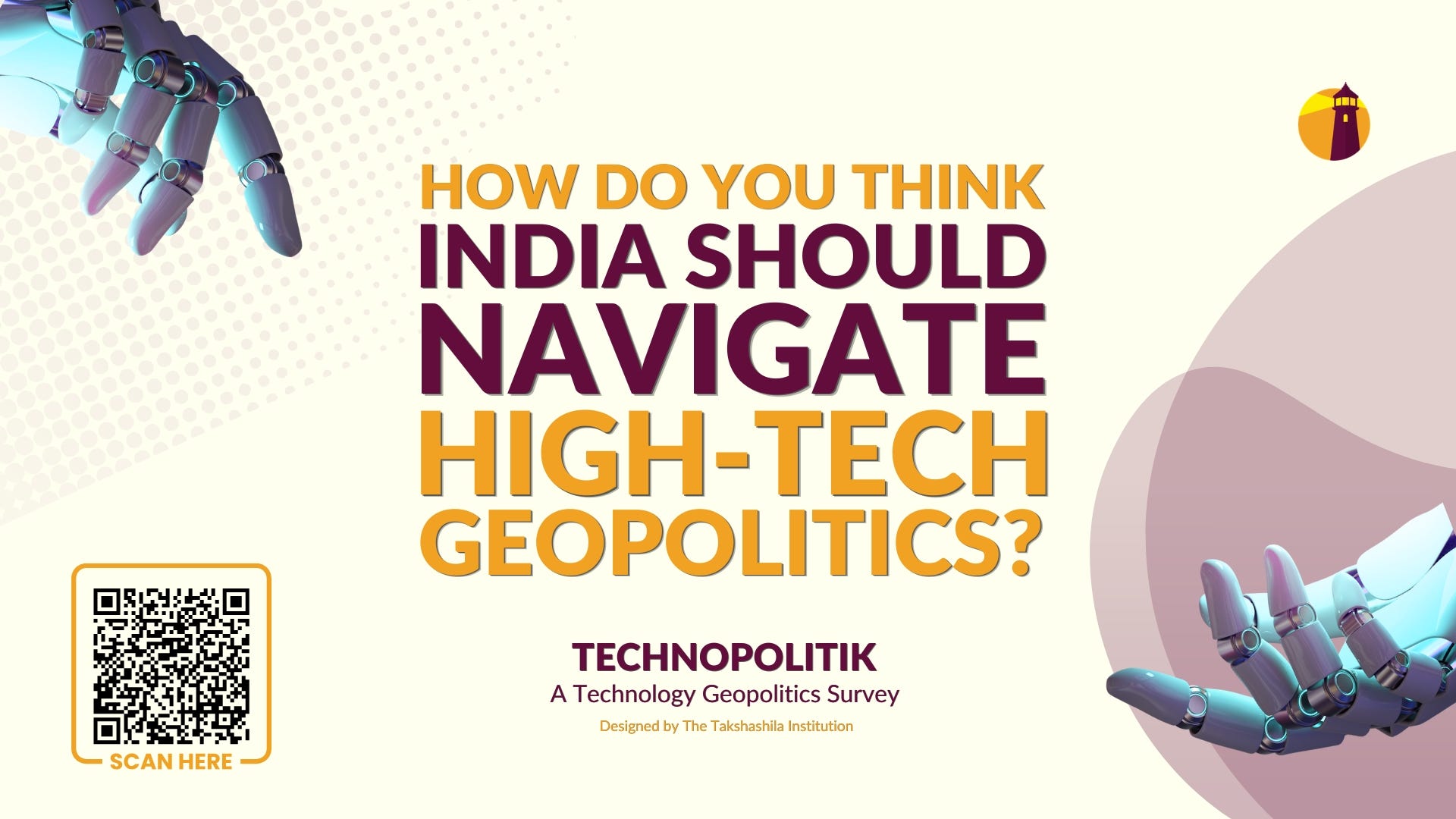
The High-Tech Geopolitics Survey
Should India build semiconductor fabs or just focus on chip design talent? On AI, should India double down on its application-layer strengths or prioritise foundational models?
If you often think about these questions, then we think you may like to take the Technopolitik survey designed by Takshashila. It aims to assess what people think about how India should navigate high-tech geopolitics.
Scan the QR code or open this link.
The ‘Space Power’ Expert Capsule Course
The Takshashila ECC, Space Power, is a fully online, four-week programme on space policy, law, and strategy. It runs on four Saturdays – September 5 to October 10, 2026 – without disturbing your daily schedule. Here’s a look at its rather fascinating modules:
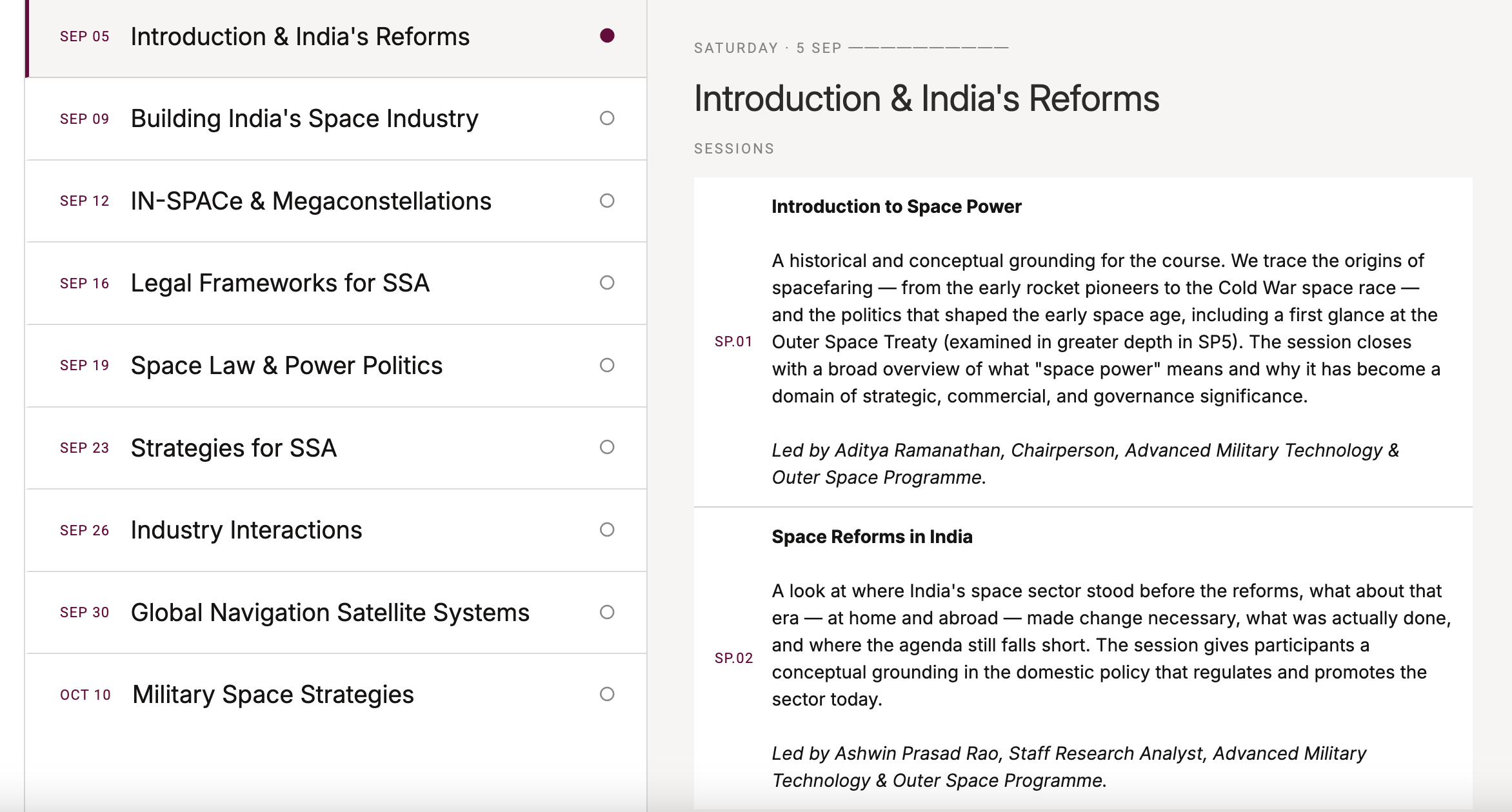
Apply by July 31 to avail the early-bird scholarship!
Three Thing Thoughts: A Messy Democracy
Anushka Saxena
The trains that left the station
On July 25, Shanghai’s official Shangguan News (上观新闻; reshared by Sina) ran a piece on a “fallout” between India and Japan over the Mumbai-Ahmedabad high-speed rail, amid the rising popularity of a tweet/ X Post by former Japanese Justice Minister Makihara Hideki, which claimed that delays on the project were “100% India’s responsibility.” The reporting itself is largely borrowed, because Makihara himself was amplifying a Toyo Keizai article arguing that once a European signalling system, the ETCS-L2, won the bid in 2025, the Japanese Shinkansen E-series’ DH-ATC system was “destined to be excluded,” and that Japanese technology now stands locked out of the standard ecosystem for India’s future high-speed rail.
Credit where credit is due, the Indian External Affairs Ministry’s rebuttal, which revolved around how Makihara never worked on the project, and how the E10 wasn’t going to deliver until after 2030, is duly quoted in Shangguan. What is interesting is the rest of the narrative aimed at Chinese audiences. One, the piece contests that the Quad partnership on the whole is fraying over something as unglamorous as signalling standards. Two, it reduces Japan from a technology contractor to an entity simply “paying to build the road.” The unstated contrast, of course, is with China’s own turnkey rail-export model, where the trains, the signalling, and the standards are packaged as one non-negotiable bundle.
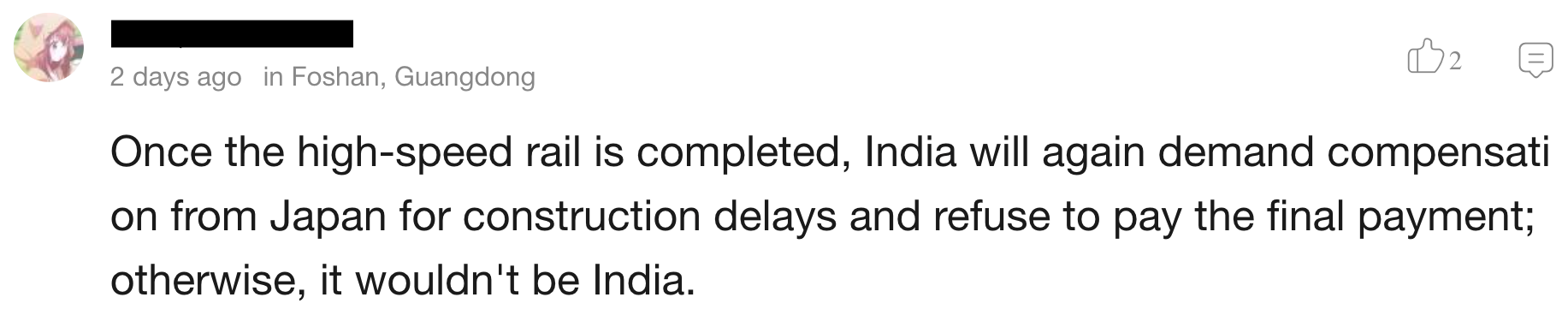
Subsequent articles and comments on the subject across Chinese social media have all glorified the so-called fallout. But inherent in the latter is the public distaste for both India and Japan. Below are two interesting examples (crudely translated on webpage), that showcase the range of contempt for Japanese infrastructure and Indian business practices. Others chime in carrying similar perceptions.

Decouplers, Beware!
Just a day before Shangguan, on July 24, a Guangdong-based finance creator writing on QQ-Tencent News announced that India’s “de-Sinicisation” (去中国化) had “ended before it even began.” The peg for the creator, Li ‘Afei’ Yunfei’s piece, is a Reuters report from July 23, itself taken from the Solar Module Manufacturers Association of India. It argues that nearly a third of India’s 140-or-so small- and mid-sized solar PV module makers have shut down after New Delhi mandated domestically produced cells for all solar projects from June 1.
Two assertions in the piece stand out. First is the references to China’s restrictions on the export of PV manufacturing equipment and technology as the “binding constraint” on India’s capacity expansion endeavours. It is always fascinating to see admissions of weaponised interdependence at play, which, in Beijing’s case, usually occur when a less powerful party is being discussed. Second is the fact that this, again, is targeted at Chinese readers. Its language framing seems almost to reassure them that Beijing still dominates supply chains.
There are indeed some vital challenges demanding Indian policy focus. For example, as the article itself suggests, 95% of cells are still imported from China, and imports themselves are up 37% Y-o-y to about US$1.86 billion. The most important are the consumer welfare and sustainability angles – relying solely on domestic alternatives is bound to raise the cost of a residential solar power plant for citizens, while certain renewable energy targets would become harder to meet. The geopolitics, of course, is in the article issuing a “wake-up call for all countries seeking to decouple.”
Light Reading?
Finally, there’s a long read on the culture and history of India-China relations published also on July 24 in the opinion section of the popular platform, Guancha. It has since gathered 113,000 reads. Written by Prof. Yu Longyu (郁龙余), a recipient of the Indian Council on Cultural Relations’ ‘Distinguished Indologist’ award in 2016, the piece argues that Sino-Indian relations are both a “key focus” (重点) and a “difficult point” (难点) of Chinese diplomacy, and that the difficulty exists, “to put it bluntly, because we don’t understand India well enough.” “Of course,” he goes on, “India also doesn’t understand us very well.” Objectively thinking, both assertions are true.
I find the essay’s framings interestingly deflationary. Yu argues that neither the boundary dispute nor the trade imbalance, neither the US factor nor the hangover (if any in India) of 1962, is the main bone of contention in bilateral ties. It is rather, as he puts it, “mutual illiteracy.” As poetic as it sounds, top commenters on his essay immediately called him out for a “budget pitch” geared towards enabling his preferred line of work.
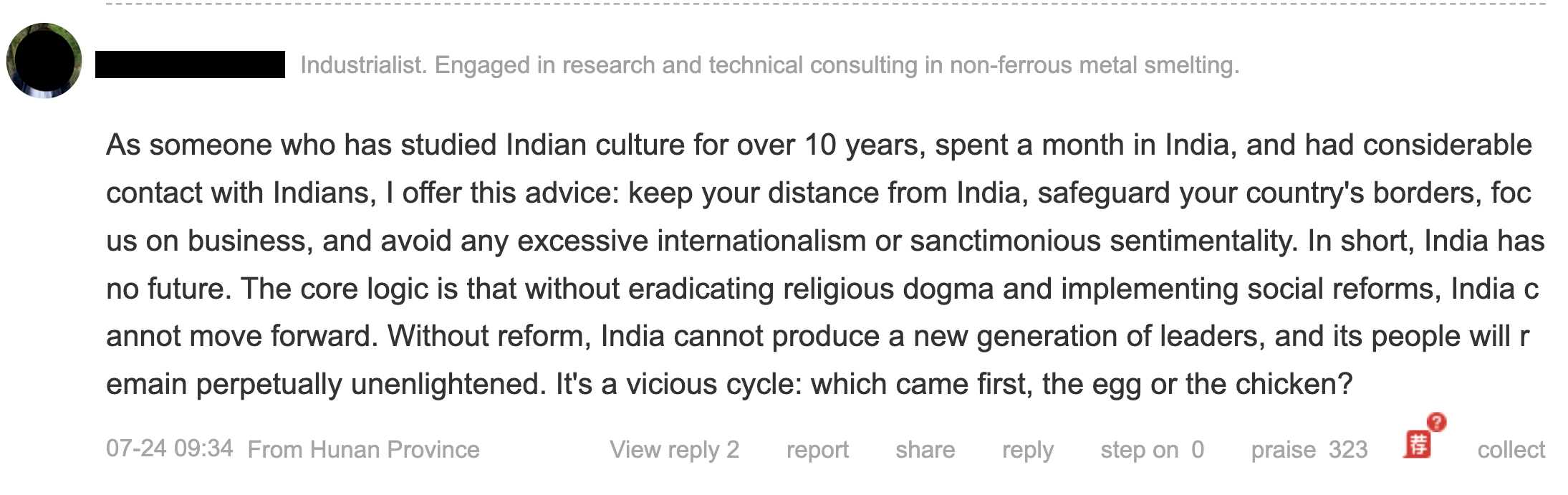
There is a lot of wrangling with concepts like shared Buddhist influence and pasts with similar experiences to make the case that if Sino-Indian ties could once be based on mutual understanding, they can be so again. And even though the academic in me sympathises, the think tanker first sees the comments – and they are rough, but more realistic from an everyday Chinese citizen’s lens. Here, for example, is a top commenter literally warning against painting a flowery picture of the future of Sino-Indian relations, coming from a claimed background in India studies:
Here’s another comment – if I’m not wrong, the one with the most ‘praises’ – quoting insights from Tsinghua University’s June 2026 ‘External Risks’ report to explain how India is not even an important diplomatic, military or cultural actor from Beijing’s point of view:
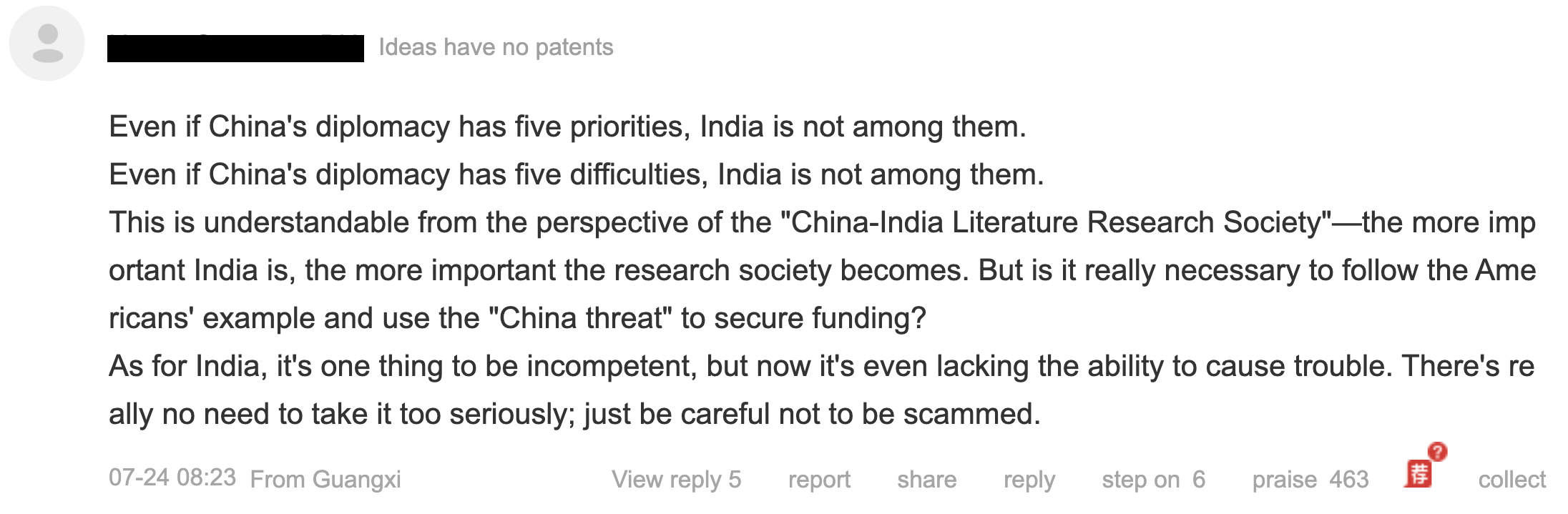
As we proceed with this section in the coming weeks, we hope to gauge the extent and range of such articles and essays – while some are exercises in furthering the cause of individuals or their affiliated institutions, others are clickbait. Some, of course, are genuine analyses of India’s messy democracy. In either case, Yu’s endeavour for mutual literacy is more important now than ever before, even as it desires enhancement through the frameworks of realism and pragmatism.
Eye on China is a weekly newsletter curated by the Geostrategy Programme at The Takshashila Institution, a public policy think-tank based out of Bengaluru, India.
