
One China, No Interpretation
Covering Chinese policy and rhetoric on external events and actors, military and security issues, economy and technology, and bilateral relations with India.

Guarding the Great Wall: Cheng-Xi Meeting
Anushka Saxena
In the past few days, the talk of the town has been Taiwanese Kuomintang (KMT) party Chairwoman Cheng Li-Wun’s visit to China for a week-long engagement with party-state officials, including a meeting with President Xi Jinping on April 10, 2026. The Cheng-Xi meeting, in particular, grabbed headlines as the first such meeting between the Chinese President and a KMT Chairperson in a decade, the last being Xi’s meeting with KMT Chairwoman Hung Tsi-Chu in Beijing in 2016.
But even before that, Xi has held meetings with KMT Chairmen twice – in 2015, with Eric Chu, and in 2013, with Lien Chan. Cheng’s visit, in that sense, has not only come after a long break – a time period in which KMT’s primary opposition party, the Democratic Progressive Party (DPP), has more-or-less dominated the Presidential post and the Legislative Yuan (the Parliament of Taiwan) – it has also come at the opportune moment when Taipei is debating a massive defence budget of US$ 40 billion to deter the mainland.
A Comparative Assessment
On Xi’s end, it is notable that the tone, tenor and points of focus across the four meetings have evolved towards urgency and a preference for ideology. In 2013, with Lien, Xi’s language was relatively optimistic and welcoming. He acknowledged that “historical issues remain” between the KMT and the CPC, and that solving them requires “time, patience, and joint efforts.” He focused on the natural “blood bond” between compatriots and specifically referred to the “one China framework” as the basis for mutual political trust.
By 2015, Xi shifted to framing cross-Strait relations as being at a “new and important juncture.” He introduced the concept of building a “cross-strait community with a shared future” (or shared destiny; 命运共同体). Unlike 2013, he explicitly warned against concepts like “one country on each side,” or “one China, one Taiwan.” He also suggested elevating the relationship by actively exploring an “institutional framework” to safeguard peaceful development, which Hung, just a year later, agrees to in principle but is unable to see through.
Xi’s articulations in 2016 became markedly stricter and more defensive. He elevated, for the first time, the opposition to “Taiwan independence” to an “inviolable red line” to a KMT Chairperson, and asserted that the mainland has the “firm will, full confidence, and sufficient capability to curb” such an endeavour. He also framed the ‘1992 Consensus’ in starker terms than previous years, stating that acknowledging it is a fundamental question of whether the two sides are “one country or two countries.” He noted additionally that complex political differences must be “resolved gradually.”
By 2026, after a 10-year gap, Xi’s remarks to Cheng focused intensely on historical continuity and the nation’s absolute indivisibility. He introduced new, sweeping rhetoric that the “territory is indivisible, the country must not be in chaos, the nation must not be scattered, and the civilization must not be interrupted.” He labelled Taiwan independence as the “culprit” that undermines peace, and vividly argued that “Different social systems are not an excuse for division.” A key takeaway from the meeting has also been Xi’s intertwining of the mainland’s contemporary goals into his Taiwan policy language, specifically tying Taiwan’s future to the “Chinese-style path to modernisation” and the successes of the 15th Five-Year Plan (2026-2030).
KMT Chairpersons, too, have reacted differently over the years. Lien, for instance, used highly specific political terminology, emphasising that both sides should “seek common ground within the framework of ‘One China’,” while “reserving differences in its connotations.” In doing so, Lien kept alive a legacy party line of the KMT – One China, Respective Interpretations (–個中國,各自表述). But he seems to be about the last KMT Chairperson to do so in a meeting with the leader in Beijing. This is even though Hung, in her electoral campaign, came up with something even more interesting, and called it – ‘One China, Same Interpretation’ (一中同表) – an articulation that then-Taiwanese President Ma Ying-Jeou upheld.
Eric Chu’s language in 2015 shifted away from the nuances of political frameworks and leaned heavily instead on ideas of economic integration. While he affirmed the ‘1992 Consensus’, his key focus was on “regional peace, environmental protection, and economic integration.” He also emphasised that the fruits of these relations should benefit specific groups, including the “grassroots people, small and medium-sized enterprises, and young people.”
In 2016, Hung used the most politically ambitious language among the KMT leaders regarding future agreements. Aside from committing to standard lines on economic and youth exchanges, she specifically called for “actively exploring the institutionalisation of cross-strait peace,” echoing Xi’s 2015 language about an institutional framework. Her prostration arguably lost the KMT an electoral victory for two consecutive terms, and a presidential victory for three.
Most recently, Cheng’s articulations have been relatively moderate, and her responses have been based solely on shared ethnic and cultural identity instead of political “cornerstones” and the ‘One China’ framework. She describes people on both sides of the Strait as “descendants of the Yellow Emperor.” Her focus is firmly placed on non-political integration, as she advocated for “safeguarding Chinese history and promoting Chinese culture” through grassroots, trade, and youth exchanges.
Brief Situational Assessment
The China-KMT relationship is a classic case of enemies-to-friends, with, of course, a history and nuance in between. Contemporarily, the KMT is the only Taiwanese party whose many members, and many aspects of whose ideology, regard the mainland as the motherland. Some of these party members are on the extreme end, even in demanding reunification, in that they desire it to be speedy and popular. An example is Ho Ying-Lu, who resigned from the KMT in November 2025 after controversy erupted following her appearance on Douyin wearing a Mao Zedong t-shirt! As a consequence, Beijing reserves a privileged status for the KMT, despite a history in the 50s and then again in the 90s, of turmoil and conflict. In policy, the KMT has also, in a sustained manner, fostered China’s favourable disposition by proposing “dialogue” over the DPP’s preferred “deterrence, defence and diplomacy” approach.
In that sense, China showers the KMT with lavish visits to cities such as Beijing and Shanghai and congratulates them on their electoral wins. Most recently, Beijing sent its congratulations to the current Chairwoman of the KMT, Cheng Li-Wun, on October 19, 2025. Subsequently, Beijing used the claim that the Chairwoman had “repeatedly expressed her desire to visit the mainland” to invite her for a weeklong visit to China. Further, Beijing has facilitated many such high-level KMT visits in the past 15 years or so under Xi, and has hosted former President Ma Ying-Jou multiple times. The Chinese do not refrain from rolling out the red carpet for the KMT.
At the same time, the DPP, and more specifically, its President Lai Ching-te, not only continue to draw Beijing’s ire, but are also branded as “separatists” and “Taiwan independence activists.” Since 2016, Beijing itself has refused to engage in dialogue with Lai and even with Tsai Ing-Wen before him. Lai, who once, in a presidential debate, referred to himself as a “pragmatic Taiwan independence worker,” has since proposed that the DPP be willing to engage in dialogue with China – an offer he has faced repeated rejection.
Hence, from Beijing’s perspective, there is a missing logical piece of the puzzle in cross-Strait relations. It is that KMT can block bills and support the ‘One China, Different Interpretations’ narrative, but cannot do much beyond that to fundamentally shape Taiwan’s policy and its people’s outlook. The DPP, with which they shirk dialogue, arguably has more executive authority and deeper ties to the US.
KMT is in a paradoxical position, in that it holds a greater number of seats in Taiwan’s parliament but is popularly weakened. In the 2024 presidential election, the KMT candidate Hou Yu-ih won 33.5% of votes (less than the previous KMT candidate in 2020), while Lai won 40%. In the legislature, the KMT won 52 seats to the DPP’s 51 – a slight edge that doesn’t translate to majority control. The TPP holds the balance with 8 seats and is more inclined toward the opposition’s agenda than the DPP’s. Crucially, the recall campaign in April-May 2025 – wherein grassroots groups, either independent or sympathetic to DPP legislators, filed to recall as many as 31 KMT legislators, while the latter retaliated by trying to unseat ~15 DPP legislators – failed, with zero recalls. No DPP or KMT legislator lost their seat.
Yet, public opinion on the KMT and its policy agenda is sobering. A Taiwan Public Opinion Foundation survey (October 2025) found only 13.9% support “unification with China,” versus 44.3% who support independence and 24.6% who support maintaining the status quo. Similarly, a National Chengchi University Election Study Center Survey (December 2025) found that in terms of party preferences, while the biggest minority of surveyed respondents (37.4%) came off as independent or non-responsive to politics, more respondents (30.8%) supported the DPP than the KMT (20.1%), and then the TPP (10.9%). And yet, if the KMT and TPP were to unite in 2028, and today’s survey results are to be taken ceteris paribus, the DPP may be in for a tough fight.
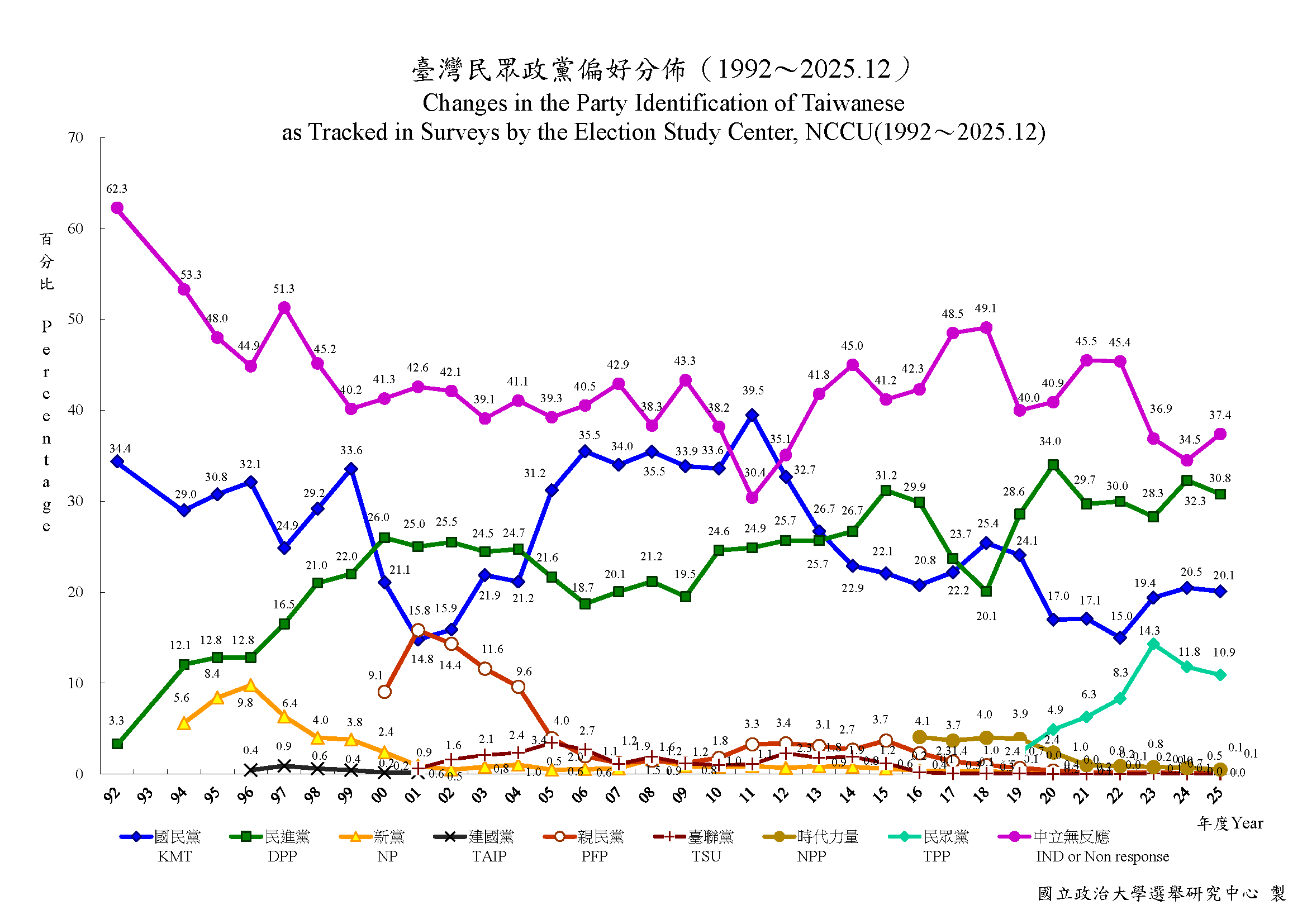
The way forward may also be determined by the KMT’s internal problems. Cheng was elected KMT chairperson with support from the party’s most conservative factions, but moderates fear she will alienate Taiwan’s mainstream voters by appearing too closely aligned with China ahead of local elections in November and the 2028 presidential election. As a result, many of them have been voicing support for larger defence budgets for Taiwan and visiting the US to project a nuanced image to the domestic electorate.
Why Now?
It is highly likely that, because the KMT lost power and the DPP dominated both the Presidential elections and the Parliamentary majority for nearly a decade, Beijing distanced itself from the KMT and hosted the party’s Chairperson in China. In the 8 years Tsai was in power, Beijing deployed other means, such as conducting large-scale military exercises against the island, and eroding its diplomatic standing by poaching as many as 10 of its ally countries for recognition towards the PRC, to ensure that Taipei’s political corridors faced more challenges.
Today, with the KMT having created a tussle in the legislative yuan by gaining a 52-51 edge in parliamentary seats over the DPP, it is as if Beijing feels more confident about revamping ties with the KMT and Chairwoman Cheng. The timing of the visit is also relevant because Taiwan is currently debating major defence spending proposals, including a special defence budget of ~US $40 billion (~NT$ 1.25 trillion) and the purchase of American arms for 100s of millions of dollars. The only hindrance to Lai’s plans is the KMT’s repeated objections, which have also led to violent brawls in the yuan. For Beijing to materially influence the outcome of the defence budget discussions, it must continue to express support for the KMT.
Cheng backs a modest NT$ 380 billion arms allocation, though senior party figures want more. However, the reality is that not only does the KMT itself have fissures within the party, with members who may not support extreme prostration before Beijing, but the people’s reaction to Cheng’s visit and hospitality toward an aggressive China may also not bode well. As a result, temporary relief for Beijing may not translate into friendly electoral outcomes in 2028. In that sense, it is also possible that Beijing sees the time between now, when the KMT is in a parliamentary lead, and the national elections are not for another two years, and October 2027, when China will be busy with its own politics amid the 21st Party Congress, as opportune for more aggresiveness towards Taiwan, and greater cooperation with the KMT.
Eye on China is a weekly newsletter curated by the Indo-Pacific Studies Programme at The Takshashila Institution, a public policy think-tank based out of Bengaluru, India.

Anushka , A well written article and I love the way you articulated this topic. Please amend the date of congratulatory message to Cheng Li-Wun to 19 Oct 2025 in place of 19 Oct 2026. Thanks for sharing
Correction updated: Xi Jinping congratulated Cheng Li-Wun on October 19 of '2025'.