
What's the Haps?
Covering Chinese policy and rhetoric on external events and actors, military and security issues, economy and technology, and bilateral relations with India.

Greetings readers! At the outset, I implore you to check out Takshashila Institution’s latest Expert Capsule Course, curated by Amit Kumar & the China team. The ECC, ‘China in the Changing Geo-economic Landscape’ is an all-virtual, four-week course designed to equip policymakers, business leaders, analysts, journalists, and students with the tools to understand the second-largest economy’s role in shaping the emerging geo-economic order.
Participants will dive deeper into issues relating to China’s phenomenal rise, its economic model, the repercussions of its rise on the global economy, weaponisation of trade, de-risking, catching up with the West, and plans to reform the global financial system.
Deadline for applications and payments is January 20, 2026. Apply soon!
Guarding the Great Wall: PLA in the Past Week
Anushka Saxena
In this edition, I aim to assess a few developments in the People’s Liberation Army and the Central Military Commission in the past few days. Coverage includes instructions to the CMC Equipment Development Department (EDD), a work brief on a battalion of the Information Support Force (ISF), and a long-ish report on a Southern Theater Command Air Force brigade’s training.
I. Refining the EDD
On December 19, 2025, the CMC EDD conducted an instructive activity on “professional ethics” and “norms of conduct vis-à-vis military equipment.” The goal of the activity was to “implement Xi Jinping’s Thought” on managing and improving equipment development, guiding equipment personnel to uphold the virtues of discipline, observe public ethics, strictly regulate private conduct, and standardise professional behaviour.
I.I The Revealed Guidelines
The norms require establishing professional values for the “New Era”: loyally manufacturing weapons for the Party, focusing on “victory” in weapon development, and maintaining integrity and cleanliness in weapon production. They require adherence to common professional conduct principles: sincere dedication to equipment work, selfless contribution, practical work and unity in strengthening equipment, innovation and striving for peaks, system-based strengthening with quality as the top priority, meticulous management and service to the troops, clean governance of equipment work and upright conduct.
Beyond the political rhetoric, the norms emphasise that:
Equipment planning and project approval must strengthen strategic management, adhere to combat-led development, ensure system construction, maintain efficiency, and enforce scientific gatekeeping, achieving strategic objectives and operational needs in the most effective, rapid, and resource-efficient manner.
Equipment pre-research, development, integrated research, and technical foundation work must adhere to independent innovation, independent control, and open exchange, firmly anchoring capability building on defeating strong adversaries.
Equipment testing and certification must be combat-oriented, standardised, rigorous, objective, fair, scientific, and agile, strengthening independent and authoritative performance of duties and firmly establishing rigid benchmarks.
Equipment procurement must always be guided by operational requirements, adhere to planned management, prioritise system construction, emphasise quality first, and ensure competitive selection, providing troops with advanced, high-quality weapons suited for real combat.
Equipment pricing management must improve standards through honest quotations (in the wake of all the anti-involution discussions), lawful pricing review, strict evaluation, and compliant pricing use. Procurement management must uphold fairness, justice, openness, orderliness, and competition to ensure quality and efficiency.
Contract performance supervision must emphasise lawful, independent, and impartial performance of duty, serving as “equipment vanguards and quality guardians” on the military-industrial front line.
I.II The Backdrop
Well-kept weapons and equipment are a key marker of military modernisation and a crucial element of national security and “rejuvenation.” In this regard, the release and implementation of these “Professional Ethics and Conduct Norms for the Military Equipment Field” by the EDD appear to be a response to deep-seated, systemic issues arising in the procurement and equipment management domains.
Assessing these guidelines against the backdrop of recent purges and disappearances of top leaders in the EDD, and historical corruption in procurement, reveals a move toward institutionalised discipline rather than just ad-hoc anti-corruption campaigns. Li Shangfu, of course, seems to have been purged due to discipline-related issues during his term as head of the CMC EDD between 2017 and 2023.
More recently, the current EDD head, Xu Xueqiang, seems to be missing from the public eye. Not only did he not attend the December 10-11 Central Economic Work Conference (which he was there for in the previous iterations in 2022, ‘23 and ‘24), but also the CPC Central Committee’s Fourth Plenary in late October 2025, as well as the commissioning of the Fujian Aircraft Carrier in early November.
It is worth noting that Xu has also had overlapping careers in the Fujian 31st Group Army overlooking Taiwan, and the CMC Political Work Department, alongside the recently purged He Weidong and Miao Hua. While it can be said with some certainty that he seems to be having work troubles, whether his disappearance and being under a potential investigation are related to corruption in the EDD or the Taiwan gang ecosystem, remains uncertain.
I.III Challenges & Risks
While the professional ethics and conduct norms guidelines are new, there is a recent history to clean-up endeavours in the EDD. One will do well to remember the 26 July 2023 Notice of the EDD entitled ‘Announcement Regarding the Solicitation of Clues to Violations of Rules and Regulations by Experts in the Bidding and Review of Equipment Procurement for the Entire Military’. Specifically, the Notice announced eight criteria by which violations by EDD officials were to be investigated, and tips were to be solicited:
Lack of self-discipline and lack of professional ethics;
Unwilling to take things seriously and afraid to confront difficulties (like accepting kickbacks to inflate project costs or overlook defects);
Careless work and errors in review (such as by exploiting loopholes in how “independent” evaluators were chosen);
Forming cliques and colluding in private (like forming “small circles” or interest groups between procurement experts and industry/ SOEs);
Favouritism, and using one’s position for personal gain (such as by manipulating procurement requirements to ‘tailor-fit’ specific companies);
Arbitrary use of power and unfair handling of affairs (such as procurement “experts” failing to be objective during technical evaluations;
Leaking information and actively disclosing secrets (such as actively leaking technical or bidding secrets to favoured contractors); and
Ineffective establishment and lack of supervision (may be, for example, higher-ups forcing subordinates to approve substandard projects).
The probable reason the new norms also emphasise “combat-led development” and “system-based quality” is that the corruption discussed above led to catastrophic readiness issues reported by US and regional intelligence in late 2023/ early 2024. Examples of such reportage include:
The “Water in Missiles”: US intelligence assessments suggested that corruption was so pervasive that some liquid-fueled missiles in the PLA Rocket Force were filled with water instead of fuel. Whether literal or a metaphor for “hollow” capabilities, it potentially pointed to contractors pocketing fuel budgets while delivering non-functional systems.
Non-Functional Silo Lids: Reports also claimed that the massive new ICBM silo fields in Xinjiang had defective silo doors that would not open or function correctly. This was likely the result of the “expert partiality” and “bid rigging” mentioned in the 2023 notice, by which construction contracts were awarded to well-connected firms that used substandard materials.
These failures meant that, while China appeared to be expanding its nuclear triad at a record pace, its actual “combat effectiveness” was compromised. This explains the 2025 report laying into rigid benchmarks surrounding “combat-orientation” and “scientific gatekeeping.”
Despite these new norms, the EDD faces structural hurdles that make corruption difficult to eliminate. Firstly, most equipment is produced by a handful of giant SOEs. Without actual market competition, “competitive selection” remains difficult to enforce. Then, because military procurement is a state secret, it lacks the public oversight that usually checks corruption. The EDD hence must ironically rely on internal policing, which is what failed in the first place. Finally, the report mentions that industry governance is a “systematic project.” This acknowledges that corruption wasn’t just a few “bad apples” but a feature of how the EDD functioned for decades.
II. An Observational Report on STC Radar Operations
“Finding joy in hardship, taking the post as home, remaining ever vigilant, and densely weaving the heavenly net.” In recent years, the [STC] unit has thoroughly implemented Xi Jinping Thought on Strengthening the Military, tempering the “clairvoyant eyes” that win battles on the “invisible battlefield,” and pressing forward toward the goal of achieving the centenary of the People’s Liberation Army as scheduled.
This is how a new report published in the PLA Daily on December 20, 2025 highlights the role of radar troops in the conflicts of the ‘New Era’, and what its operators in the Southern Theater Command are required to focus on.
The report provides a window into the STC Air Force’s radar units. It highlights a pivot from traditional, static territorial defence to high-mobility, joint “system-of-systems” operations. Even though it contains long and metaphorically-worded discussions on various exercises conducted by STC Air Force brigades in the radar management and use domain, there are a few notable takeaways.
Firstly, one of the most critical phrases in the report is, “Leaving the Mountains and Islands, Moving Toward the Vast Battlefield.” Specifically, the report, discussing a training exercise of radar operations tracking enemy movements on screen, says:
“As long as personnel are at the position, the antenna must rotate; as long as personnel are present, intelligence must flow – this is the mission radar troops must uphold,” a unit leader tells the [PLA Daily] reporter. “Leaving the mountains and islands and moving toward the broader battlefield, we will extend the reach of victory to more places and wider spaces.”
Historically, PLA radar troops have been positioned on fixed mountain peaks or remote islands. The report acknowledges these are “priority targets for the opponent’s early strikes.” But in the STC, Air Force units are now prioritising mobility-based survival. They are practising “rapid relocation” and setting up equipment in “unfamiliar terrain.” The suggestion potentially is that the PLA is preparing for a high-intensity conflict where fixed sensors are expected to be destroyed in the opening minutes, and radio-mobility will be key going forth.
The mention of a mobile detachment being transferred to a northern region to test the limits of extreme cold is also important. Usually, the STC operates in tropical areas, but is now ensuring its equipment and personnel are “all-weather” and “all-region” capable. To this end, an on-site unit commander argues:
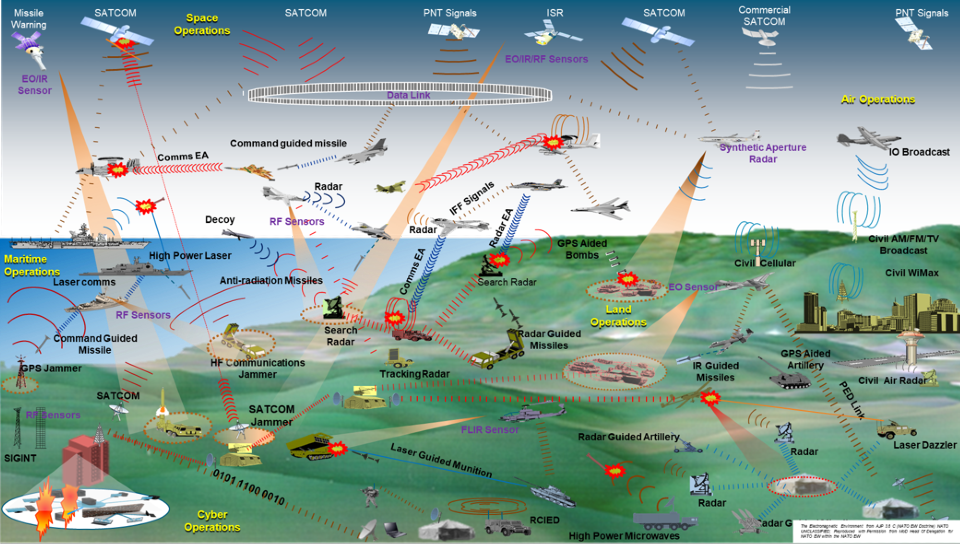
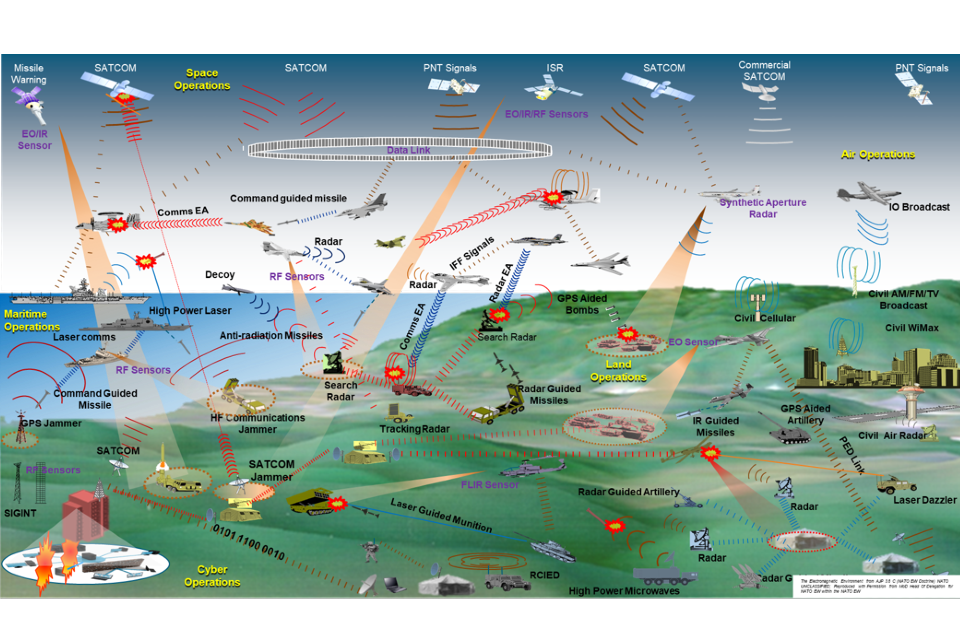
“Since the beginning of this year, the unit has continuously conducted full-factor, cross-domain rotational training, steadily improving its ability to execute missions in complex electromagnetic environments and unfamiliar terrain. Only by making radar systems ‘move and run’ can we maximally temper the unit’s ability to carry out missions in complex electromagnetic environments.”
By the way, here is an excellent diagrammatic representation of a ‘Complex Electromagnetic Environment’ in the military Multi-Domain Integrated Joint Operations ecosystem:
Counter-EW and counter-interference are also emphasised in the drills. The gist is that the report highlights operators:
“Manipulating equipment to evade interference,”
Specifically training for “enemy” aircraft that use low-altitude concealed penetration to evade detection, and
Instead of just following manuals, “digging deep into equipment potential” to develop innovative new counter-interference measures.
Secondly, the report focuses on marking a shift away from a siloed service- or unit-specific model toward one that represents a “unified web weaving a shared net.” Essentially, while discussing an exercise conducted jointly by STC Air Force and Navy Units, the report explains that each of their radars previously operated independently. Now – as the theater, by the way, should have already taken care of a long time ago – joint exercises see the two services’ units fill each other’s “blind spots.” Radar intelligence sharing, among things, is a part of this endeavour. The report articulates this in the following manner:
“‘Enemy’ aircraft are using low-altitude concealed penetration to evade radar detection!” A small, multi-service, system-of-systems coordination exercise quietly begins. This unit and a Navy unit jointly weave the “heavenly net,” handling air-situation responses.
During training, the two units support each other and fill each other’s blind spots. Radar intelligence, command orders, equipment status, and multiple “enemy” target data are synchronously displayed. Participants jointly tackled issues of operational data sharing and air-situation fusion, exploring and summarising multiple new tactics and methods.
“In the past, it was ‘each guarding one patch of sky’; now it’s ‘weaving one shared net,’” [a mid-level officer, Ouyang Bin] says, pointing to the air-situation display. “In unit-level training, I’m just one point on the map; as coordination deepens, I must step out and look down on the entire net.”
Third, and finally, is the deliberation on individual star performers’ capabilities in the STC radar work domain.
In the case of Master Sergeant Li Gang, for example, the report explains that he is an experienced technician approaching the end of his service and has been accustomed to rapidly setting up a “new type of radar.” This potentially speaks to the PLA’s reliance on senior Non-Commissioned Officers (of which Master Sergeants, 1st to 4th class, are ranks) to bridge the gap between old-school experience and high-tech new equipment.
Then, there is a division of roles shown in taking the names of Radar technician Ma Qiang, Commander Luo Min, and Officer Li Juecan. Ma leads “technical backbones” in assessing the electromagnetic environment of the target area and simulating counter-interference measures. At the same time, Luo organises teams to optimise position-establishment procedures based on a review of training data, and ensures that personnel conduct coordinated drills to ensure seamless linkage. Li is an instructor, and the length and breadth of his teaching and technical expertise is depicted in his 300 alumni and 100+ grassroots discussions on what it means to translate instructions into practical results on the frontline.
Last, but not least, is Ouyang Bin, who is made out to be “a leader spearheading ‘operational coordination meetings’ across services.” He comes off as a mid-level officer given the responsibility and empowerment to initiate institutional mechanisms. The report highlights:
Ouyang Bin led preparations for the first “operational coordination meeting.” He visited nearby units across services, spearheading the development of institutional mechanisms: creating a “single coordination table,” streamlining data flow, shortening processing time; using multiple information-technology tools to accelerate data integration and support air-situation assessment; breaking service barriers and establishing rapid-response mechanisms to ensure efficient data sharing across different posts.
III. The ISF Handles “Sensitive Matters with Transparency”
In mid-December, an ISF Battalion convened a general assembly of officers, soldiers, and civilian personnel to brief them on rank promotions, grade adjustments, and post assignments, bringing “closure” to the year’s handling of “sensitive matters.”
The political commissar of the battalion explains:
“Sensitive matters involve officers’ and soldiers’ vital interests and carry strong policy and principle requirements. The more they are hidden, the more doubts and speculation arise,” the battalion political commissar explained. They insist on full transparency, promptly publicising standards, quotas, procedures, and results, and proactively addressing concerns to correct misunderstandings.
Interestingly, why this supervision exercise is being conducted is to do soldier reselection and demobilisation. The description of the activity includes aspects like on-site grading of theoretical exams, on-site confirmation of physical fitness results, and on-site supervision of retests; i.e., who stays and who goes depends entirely on capability. Moreover, probably, the repeated emphasis on “sensitive matters” (敏感事项) reflects a long-standing PLA concern that opaque promotions on the one hand, and demobilisation on the other, undermine morale, or even organisational legitimacy. This may be truer for the new technically specialised forces – the ISF and the cyber and aerospace forces – given their reliance on civilian-grade engineers.
Further, for officer promotions, they consider a laundry list of factors, including personal willingness, collective opinion, grassroots needs, and standing committee recommendations, to ensure the right people are placed in the right positions.
An example from the report is as follows:
Recently, an engineer applied for evaluation for the associate senior professional title. Initially, he felt uneasy because long-term task deployments prevented him from “personally reporting” to leaders. Unexpectedly, the battalion shifted decision-making forward, appropriately delegating recommendation authority to unit Party branches. During the defence session, experts announced scores and rankings on the spot, with no concealment – everything was clear. “Now I see my earlier worries were unnecessary,” the engineer said after passing the evaluation.
At a deeper level, the report also serves the signalling function of reinforcing a shift from seniority-based advancement toward performance- and capability-based selection. But there is also a political education angle, given the inclusion of the above-mentioned “success story” and the mention of “record levels of satisfaction” reported by battalion troops on a survey.
Eye on China is a weekly newsletter curated by the Indo-Pacific Studies Programme at The Takshashila Institution, a public policy think-tank based out of Bengaluru, India.
